
.webp&w=3840&q=75)


Messina Bridge: Construction Project for Record Suspension Bridge Officially Approved
Messina Bridge: Project Approved

kk
Groundbreaking construction project: The future record bridge to Sicily is taking shape.
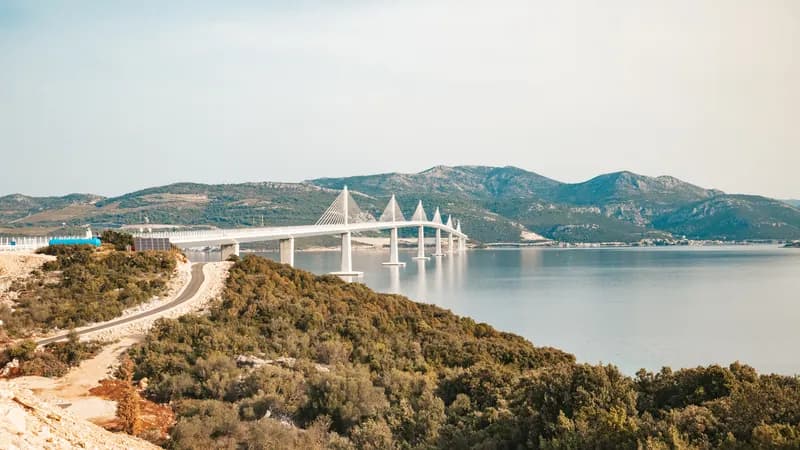
In the near future, crossing between Calabria and Sicily is set to become spectacularly simple: After decades of plans, controversies, and postponed decisions, the construction of the longest suspension bridge in the world – over the Strait of Messina – is coming closer to reality. The Italian government under Prime Minister Giorgia Meloni and Infrastructure Minister Matteo Salvini has finally approved the ambitious project, signaling progress but also renewed debates about nature, safety, and billion-dollar investments.
Vision between two continents
The idea of firmly connecting Sicily and the Italian mainland dates back to antiquity. However, it was not until 1969 that concrete feasibility studies were initiated. Time and again, the construction seemed within reach, only to fail due to political disputes, high costs, and concerns about environmental protection and earthquake risks. Hardly any infrastructure project in Europe is as closely linked to the hopes and fears of an entire region.
With a total length of nearly 3.7 km and a main span without support pillars of 3.3 km, the structure breaks all previous records – leaving Turkey's Çanakkale Bridge, which is currently the longest suspension bridge in the world, far behind. The experienced construction company WeBuild, which was responsible for the Çanakkale Bridge, is in charge of the project. It is planned to have six lanes for cars as well as a dual-track railway connection; up to 6000 vehicles and 200 trains per hour could soon reach sun-drenched Sicily within ten minutes – a revolution, as ferry crossings currently take about one and a half hours, and rail transfer takes more than two hours.
Engine for economy, mobility, and integration
The Messina Bridge is intended to be more than just a transportation project: it is seen as a driving force for the development of Southern Italy, strengthening the regional economy, providing new jobs, and improving infrastructure between North and South. For Italy, this opens the gateway to a European transport network that stretches from Berlin to Rome to Palermo – and promises, not least, a significant acceleration and facilitation of goods traffic.
Another argument is the environment: According to initial studies, significant reductions in ferry operations could save several tens of thousands of tons of CO₂ annually. Defense policy also plays a role: In the NATO context, the bridge is classified as "security-relevant infrastructure" and can therefore be co-financed with billions from the defense budget. According to government statements, the investments amount to 13.5 billion euros, spread over the next ten years.
Between encouragement, fear, and the drive to explore
However, the megaproject remains controversial. From the beginning, the enormous challenges have been addressed: In particular, the seismic activity in the region has caused unease among scientists and residents. Geologists regularly point to the earthquake risk of the Strait of Messina – in 1908, the most severe tremor in Europe in the 20th century occurred here. However, modern engineering counteracts this: suspension bridges, as highlighted by the construction company WeBuild, are considered particularly resilient against seismic forces. Examples from Japan, California, and Turkey show that comparable projects can also succeed in high-risk zones.
"We stand before a bridge that opens the gateway to Europe and will serve as a symbol of change and economic recovery for Southern Italy. The engineering required here demonstrates how far we can now withstand even adverse natural conditions," emphasizes a spokesman for the Italian Ministry of Infrastructure.
While many business representatives and local politicians celebrate the bridge euphorically as a signal of new beginnings, nature conservation remains a critical issue: associations warn of an increase in urban sprawl and disturbances to sensitive habitats. However, there is currently little political support for more environmentally friendly solutions or even a complete abandonment of the project.
Decisive phase and uncertain timelines
Although the interministerial committee officially approved the construction project on August 6, 2025, there is still a crucial step remaining: the Italian Court of Auditors must review and approve the project. Meanwhile, initial archaeological and geological explorations are beginning, but actual construction work is not yet permitted. The official kickoff could still be weeks or even months away. Therefore, the completion date remains uncertain, as well as when the first cars will actually roll over the "Gateway to Sicily."
In an international comparison, the trend of promoting such megastructures becomes apparent – whether as a railway tunnel between Germany and Denmark or boldly curved bridges in China and the Middle East. The Messina Bridge could, if it becomes a reality, mark a milestone in European engineering, but it could also serve as a touchstone for sustainability and social consensus.
Further information can be found by interested readers at European infrastructure authorities, renowned environmental organizations, as well as current reports from the Italian government.
Advertisement
Advertisement
Advertisement
Poll Of The Day
Wie lange sollte dein perfekter Urlaub dauern?
- A.Kurz & knackig
- B.Eine Woche
- C.Zwei Wochen
- D.Drei Wochen+
- E.Je länger, desto besser
- F.Hauptsache überhaupt Urlaub
LGBTIQ+ News

Von Olympia zu OnlyFans - Mexikanischer Gewichtheber zeigt sich freizügig online

Bolt-Fahrer verurteilt - Homophobe Entgleisungen kosten 800 Euro Strafe

Wirbel um Escort-Recherche - Schwuler US-Influencer berichtet von Morddrohungen

Absage an bisexuelle Männer - Neue Dating-Umfrage zeigt deutliche Unterschiede
Most Read


Advertisement
Video Of The Day
Advertisement
Advertisement
Advertisement
Poll Of The Day
Wie lange sollte dein perfekter Urlaub dauern?
- A.Kurz & knackig
- B.Eine Woche
- C.Zwei Wochen
- D.Drei Wochen+
- E.Je länger, desto besser
- F.Hauptsache überhaupt Urlaub
LGBTIQ+ News
Von Olympia zu OnlyFans - Mexikanischer Gewichtheber zeigt sich freizügig online
Bolt-Fahrer verurteilt - Homophobe Entgleisungen kosten 800 Euro Strafe
Wirbel um Escort-Recherche - Schwuler US-Influencer berichtet von Morddrohungen
Absage an bisexuelle Männer - Neue Dating-Umfrage zeigt deutliche Unterschiede
Most Read
Advertisement
Video Of The Day
Ellinikon opens first part of the mega project
Tórshavn approves new rainbow crosswalk
EU approves new border crossing at Lake Prespa
Citizens' Initiative Secures Six-Year Opening of Poveglia as a Public Park

Rainbow Bridge
Le Capannine

The Bridge
Puente Romano Beach Resort
Water & Sound Festival: Waterways Re:Imagined – Concert by Laura Misch
Water & Sound Festival: Waterways Re:Imagined – Conversation with Sathnam Sanghera

Mega Malle 2025 - The Festival of Mallorca Megastars