
.webp&w=3840&q=75)


Three Top Destinations for Whale Watching in Europe
Nature-oriented parking spaces on site

kk
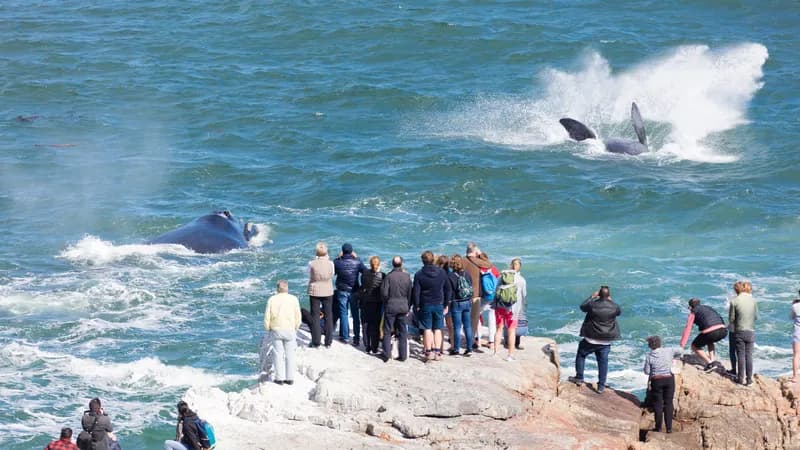
Those who want to experience Europe's largest whales in the wild today have three particularly rewarding travel destinations: Andenes and Tromsø in Norway, Tarifa in Spain, and the Pelagos Sanctuary in the Mediterranean. These locations have established themselves as hotspots with proven whale-watching tours and suitable camping spots for motorhomes, where nature lovers have realistic chances of spotting different whale species.
The most important points at a glance
- In Andenes, Norway, sperm whales can be observed almost year-round.
- In Tarifa, southern Spain, orcas, fin whales, and dolphins can be regularly spotted from March to October.
- The Pelagos Sanctuary between Liguria, Sardinia, and the Côte d'Azur is home to twelve species of marine mammals, including fin whales and sperm whales.
- Reputable providers pay attention to maintaining a respectful distance from animals during guided tours.
- All the mentioned places have designated, nature-oriented parking spaces for motorhomes.
Norway: Sperm whales between midnight sun and northern lights
The small harbor town of Andenes on the Vesterålen is regarded as a Norwegian insider tip for whale watching. Travelers who venture above the Arctic Circle in the far north are rewarded there with glacier views, fresh sea air, and year-round high chances of spotting sperm whales. Thanks to the Gulf Stream, the climate remains milder even in winter than many expect. Those who book a whale-watching tour usually start directly from the harbor. The residents of the nearby village of Bleik can reach the nearby campsite in just a few minutes on foot, while up to 60 camper vans enjoy a direct sea view. The infrastructure provides everything needed for a relaxing stay.
In winter, adventure seekers travel further to Tromsø, where humpback whales, orcas, and sometimes fin whales follow the herring into the fjords. Despite the polar night, temperatures remain surprisingly pleasant thanks to warm ocean currents. Bookable whale-watching tours can be combined with an overnight stay at the peacefully located Tromsø Camping. There, in addition to electricity and sanitary facilities, there are even charging stations for electric vehicles. Due to good public transport connections, the Norwegian harbor city can be quickly reached even without a personal vehicle.
Andalusia: Whales in the light of the Strait of Gibraltar
Spain's southernmost point at Tarifa presents itself as significantly warmer. The season begins in March and lasts until October. The strait between the Atlantic and the Mediterranean offers ideal conditions to experience fin whales, orcas, and various species of dolphins. Providers like Firmm, which conduct the outings responsibly, score with a 99 percent sighting guarantee. The camper van site Area La Marina is centrally located and is particularly suitable for self-sufficient vehicles, as additional infrastructure has been omitted – however, the sea is just outside the door.
Mediterranean: Pelagos – Protected Area for Gentle Giants
The Pelagos Sanctuary, an 87,000 square kilometer marine protected area between Liguria, Sardinia, and the Côte d’Azur, is one of Europe's most significant refuges for whales. Here, twelve different species can be observed. In particular, Genoa, known for its historic old town, is a starting point for guided whale-watching expeditions. Those who want to stay close to nature can find a quiet spot in the forest at Campeggio Villa Doria, which offers a bread delivery service and bus connections to the city center.
"The chances of observing even large fin whales close to the shore in the Pelagos Sanctuary are better than anywhere else in Europe," says marine biologist Dr. Silvia Bonizzoni from the Tethys Research Institute.
To permanently protect the animals, the protected area works closely with local authorities, research institutions, and environmentalists.together inside, which enhances the experience for visitorsmakes it particularly sustainable.
What comes next for sustainable whale watching?
Especially during the summer months, the demand for offerings increases even more. At the same time, the responsibility of the organizers to attentively ensure distance and provide information grows. Serious providers, clear rules, and protected habitats make the observation of large marine mammals an unforgettable, safe experience in Europe – ensuring that this remains possible in the future.
Advertisement
Advertisement
Advertisement
Poll Of The Day
Wie sieht dein queerer Traumurlaub aus?
- A.Pride & Community
- B.Gay Beach & Sonne
- C.Party & Nightlife
- D.Wellness & Erholung
- E.Kultur & Sightseeing
- F.Abenteuer & Action
LGBTIQ+ News

Ende der Badehaus-Verbote - Schwule Treffpunkte werden vielerorts in den USA neu bewertet

KI und LGBTIQ+ - Wenn Algorithmen über Identitäten urteilen

Doppelmoral in Dallas - Zu viele Grindr-Zugriffe beim Parteitag der Republikaner

Mit Pride-Flagge ins Ziel - Ryan Montgomery läuft für queere Sichtbarkeit
Most Read


Advertisement
Video Of The Day
Advertisement
Advertisement
Advertisement
Poll Of The Day
Wie sieht dein queerer Traumurlaub aus?
- A.Pride & Community
- B.Gay Beach & Sonne
- C.Party & Nightlife
- D.Wellness & Erholung
- E.Kultur & Sightseeing
- F.Abenteuer & Action
LGBTIQ+ News
Ende der Badehaus-Verbote - Schwule Treffpunkte werden vielerorts in den USA neu bewertet
KI und LGBTIQ+ - Wenn Algorithmen über Identitäten urteilen
Doppelmoral in Dallas - Zu viele Grindr-Zugriffe beim Parteitag der Republikaner
Mit Pride-Flagge ins Ziel - Ryan Montgomery läuft für queere Sichtbarkeit
Most Read
Advertisement
Video Of The Day

Ranking - The Most Beautiful Places in Europe

Greenland, Serbia, Morocco, and Georgia: Alternative Destinations in Sustainable Tourism
Prince of Whales

Prince of Whales Whale & Marine Wildlife Adventures

Now officially: Here it is clear

Anafi is Europe's quietest island

Safartica

Aavameri

The Sirens: Drag on the Spree with Jade Pearl Baker

Wine Market on the Cologne Rhine – Opening Day

Hamburg: Winter Pride 2024